


Virtualization has fundamentally changed how enterprise data centers operate. Instead of dedicating one physical server to one application, organizations now run dozens of virtual machines or containers on a single host, improving resource utilization and simplifying IT management. As virtualization platforms continue to evolve, however, they also place greater demands on network infrastructure.
Whether an organization is deploying VMware, Microsoft Hyper-V, or Kubernetes-based container platforms, the volume of east-west traffic inside the data center continues to increase. In many environments, 10G networking is no longer sufficient to support modern workloads. As a result, 25G SR optical modules have become a practical upgrade, providing higher bandwidth while making full use of existing multimode fiber infrastructure.
Virtualization Is Driving More East-West Traffic
Traditional enterprise networks were dominated by north-south traffic, with data moving between users and applications. Modern virtualized environments are different. Virtual machines, containers, and storage systems communicate constantly within the data center.
Examples include virtual machine migration, distributed storage synchronization, backup operations, database replication, and communication between microservices. These workloads generate significant east-west traffic, placing increasing pressure on server connections and Top-of-Rack (ToR) switches.
As server density grows, network congestion can quickly affect application responsiveness and overall system performance.
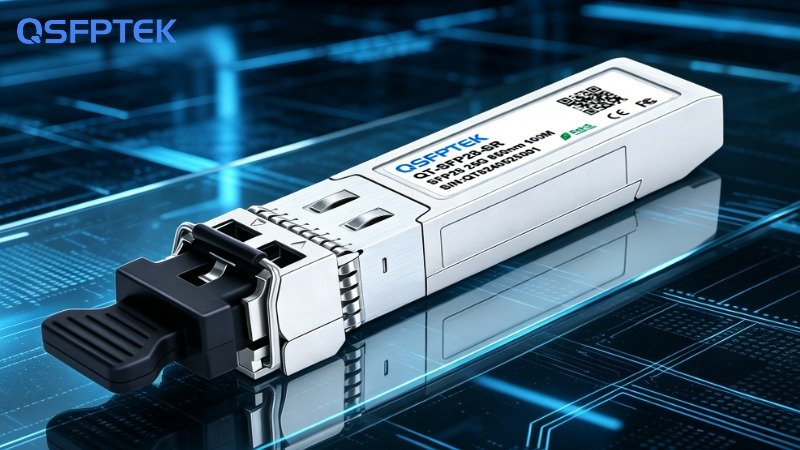
Why 25G Is Replacing 10G Server Connectivity
For many years, 10G Ethernet was the standard interface for enterprise servers. While it remains suitable for some workloads, today’s virtualized environments often require more bandwidth than a single 10G link can provide.
A 25G SR module delivers 2.5 times the bandwidth of a 10G connection without significantly increasing cabling complexity. Most modern servers and network interface cards (NICs) now support native 25G Ethernet, making it a natural choice for new deployments.
Because 25G SR operates over OM3 or OM4 multimode fiber, many organizations can upgrade network capacity without replacing their existing fiber infrastructure. This reduces deployment costs while improving overall network performance.
Supporting VMware and Hyper-V Platforms
Virtualization platforms such as VMware vSphere and Microsoft Hyper-V rely heavily on fast, reliable network connections. Multiple virtual machines often share a single physical host, while storage traffic, management traffic, and live migration occur simultaneously.
Deploying SFP28 SR links between servers and ToR switches provides additional bandwidth to accommodate these workloads. Higher throughput helps reduce network bottlenecks during virtual machine migration and improves access to shared storage resources.
For enterprises planning to expand virtualization clusters, 25G connectivity offers greater scalability without introducing unnecessary complexity.
Enabling High-Performance Kubernetes Clusters
Containerized applications have become another major driver of data center traffic. Kubernetes clusters distribute workloads across multiple worker nodes, with applications continuously exchanging data through microservices, service meshes, and storage platforms.
Unlike traditional applications, containerized workloads often generate a large number of short, frequent network connections. This communication pattern increases the demand for low-latency, high-bandwidth server connectivity.
25G SR modules provide the network capacity needed to support Kubernetes environments while maintaining straightforward deployment inside the data center.
A Cost-Effective Upgrade for Enterprise Networks
One of the main advantages of 25G SR is its balance between performance and cost. It offers a substantial improvement over 10G while avoiding the higher investment required for 100G server access in environments where such bandwidth is unnecessary.
By leveraging existing multimode fiber and widely available 25G Ethernet hardware, organizations can modernize their virtualized infrastructure without undertaking a complete network redesign.
Conclusion
As virtualization technologies continue to evolve, network infrastructure must keep pace with increasing east-west traffic generated by virtual machines, containers, and distributed applications. Upgrading server connectivity to 25G provides the bandwidth required to support these workloads while preserving a simple and cost-effective architecture.
For organizations running VMware, Hyper-V, or Kubernetes platforms, 25G SR optical modules offer a practical solution for improving network performance, enhancing scalability, and preparing virtualized data centers for future growth.