

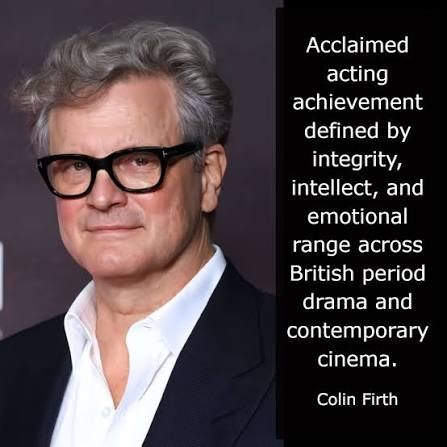
His best-known men stand upright, choose their words carefully and hide desire, fear or grief behind formal manners. Firth spent part of his childhood outside Britain, disliked school, changed his accent to survive among classmates and entered the profession through a play that became a remarkable nursery for British acting talent. Fame arrived slowly, then attached him to one fictional surname so firmly that another successful character was created partly as a joke about it.
1. The Outsider Who Learnt to Perform Before Acting Professionally
Colin Andrew Firth was born on 10 September 1960 in Grayshott, Hampshire, into a family shaped by teaching, religion and travel. His mother, Shirley, lectured in comparative religion, while his father, David, taught history and worked as an education officer for the Nigerian government. Several grandparents had served as missionaries, and both parents had spent part of their own childhoods in India. The supposedly archetypal English actor therefore grew up with international movement embedded in his family history.
Firth spent some of his earliest years in Nigeria because of his father’s work. Childhood abroad did not give him the fixed sense of place often associated with the restrained Englishmen he later played. His family returned to England, and at about 11 he also lived for a time in St Louis, Missouri. He later described that American period as difficult. Moving between countries exposed him to different speech patterns and social rules, but it also made him conspicuous at an age when fitting in mattered.
School in England brought another lesson in adaptation. Firth attended Montgomery of Alamein Secondary School, now Kings’ School, in Winchester. He felt like an outsider and encountered bullying. Rather than preserve the careful speech associated with his educated family, he copied the local working-class Hampshire accent used by other pupils. He also imitated their lack of interest in academic achievement. The change was protective performance: altering his voice and behaviour reduced the distance between him and the group.
Firth’s resistance to school was not evidence that he lacked curiosity. He found much of formal education dull and disconnected from what interested him, and his marks reflected that rejection. An enthusiastic English teacher, Penny Edwards, later changed his relationship with literature at Barton Peveril Sixth Form College. Firth has described those two years as among the happiest of his life. The episode matters because it separates academic compliance from intellectual appetite. Once a teacher connected books to emotion and ideas, the disengaged pupil responded.
Acting had already offered Firth a more direct form of engagement. He attended drama workshops from the age of ten and decided at about 14 that he wanted to act professionally. Punk culture also appealed to the adolescent who distrusted polite authority. Photographs and recollections of his youth sit awkwardly beside the later image of impeccable suits and country houses. The young Firth was not training to become the nation’s preferred gentleman; he was searching for a language that felt less conventional than school.
Firth eventually moved to London and joined the National Youth Theatre, where he worked in the wardrobe department rather than stepping immediately into leading roles. That practical position placed him close to professional theatre while reminding him that talent did not grant instant access to the stage. He later studied at the Drama Centre London, an institution known for demanding psychological and physical training. The route helped replace instinctive adolescent performance with disciplined technique.
Those early experiences explain part of Firth’s unusual screen presence. His characters often appear socially secure, yet the audience senses constant internal adjustment. He understands how a person studies a room, modifies a voice or conceals discomfort to avoid exposure. That knowledge did not come solely from drama school. It began with a child moving between Nigeria, America and England, then learning that identity could be altered through sound, posture and restraint.
2. Two Parts in Another Country and a Slow Route to Stardom
Firth’s professional breakthrough came through Another Country, Julian Mitchell’s drama about privilege, sexuality, loyalty and political rebellion inside a 1930s English public school. The play became famous for launching or accelerating the careers of several young actors, including Kenneth Branagh, Rupert Everett and Daniel Day-Lewis. Firth joined its West End production after completing his training and took over the central role of Guy Bennett, a pupil whose experiences anticipate the life of British spy Guy Burgess.
The film adaptation created an unusual switch. Rupert Everett played Bennett on screen, while Firth took the role of Tommy Judd, the committed Marxist originally performed on stage by Kenneth Branagh. Firth therefore became the only actor closely associated with both leading parts across major versions of the story. The change also placed him on the opposite side of the drama’s central friendship: from the charismatic outsider wounded by the establishment to the intellectually severe student who expects political history to defeat it.
The 1984 film gave Firth an important screen introduction, but it did not turn him into an immediate star. Several colleagues appeared to accelerate past him, while he built a career through theatre, television and film roles of uneven visibility. Journalists later grouped him with the so-called Brit Pack, yet the label suggested a shared upward movement that did not accurately describe each career. Firth’s progress was gradual, with long stretches in which recognition belonged to a particular performance rather than to his name.
His early work already displayed more range than the romantic label later allowed. In the 1987 film A Month in the Country, he played a traumatised veteran restoring a medieval mural after the First World War. The character’s emotional damage emerged through small reactions rather than explanatory speeches. In the television film Tumbledown, Firth portrayed Robert Lawrence, a British officer seriously wounded during the Falklands War. The production examined disability, anger and the inadequate treatment of returning soldiers, subjects far removed from drawing-room courtship.
Firth played the calculating Valmont in Miloš Forman’s 1989 adaptation of Les Liaisons dangereuses. The film suffered from comparison with Dangerous Liaisons, released the previous year with John Malkovich in the equivalent role. Timing limited its impact, even though Valmont gave Firth a chance to play charm as a weapon rather than a sign of decency. The experience formed part of a recurring pattern: substantial work did not always produce proportionate commercial momentum.
The slower period also protected Firth from becoming fixed too early. He experienced enough disappointment to distrust easy narratives about success, while varied parts prevented one youthful performance from defining him completely. By the time Pride and Prejudice arrived, he was 34 and had spent more than a decade working professionally. Mr Darcy was not the discovery of an inexperienced actor. It was the public recognition of techniques developed across soldiers, aristocrats, political radicals and emotionally injured men.
Firth did not initially view Darcy as an uncomplicated romantic prize. He saw the character as arrogant, socially constrained and nearly incapable of communicating emotion. That interpretation supplied the tension required by Jane Austen’s story. Darcy attracts Elizabeth Bennet only after he confronts his pride and changes his conduct; good looks and wealth do not erase his first proposal’s insulting assumptions. Firth played the moral education rather than treating reserve as automatic nobility.
3. The Wet Shirt, the Darcy Trap and the Art of Self-Parody
The BBC’s 1995 adaptation of Pride and Prejudice turned Firth into an international romantic figure. Andrew Davies’s script gave the male characters a more visible physical life than earlier adaptations, while the six-part format allowed Darcy’s behaviour to change by degrees. Firth balanced offence, embarrassment, desire and self-command without asking viewers to like Darcy too soon. The result made a difficult man compelling before it made him lovable.
One short sequence acquired a cultural life larger than the programme. Darcy returns unexpectedly to Pemberley after swimming in a lake and encounters Elizabeth while wearing a wet white shirt. Popular memory often changes the details: he does not dive into the water fully dressed, and Austen wrote no such episode. The scene nevertheless became shorthand for restrained sexuality because it temporarily strips Darcy of social preparation. Elizabeth meets him before he can restore the formal exterior through which he normally controls every encounter.
The industry soon used that association deliberately. Helen Fielding had already drawn inspiration from Austen when creating Bridget Jones’s Diary, and the screen adaptation cast Firth as Mark Darcy. The surname made the joke explicit, but the performance did more than repeat the earlier character. Mark wears a disastrous Christmas jumper, becomes involved in a clumsy street fight and struggles to express affection without sounding severe. Firth converted his romantic authority into comic material while retaining enough sincerity to make the relationship credible.
Firth continued to puncture his dignity in later popular films. In Love Actually, he played Jamie, a writer betrayed by his partner and forced into an awkward cross-language courtship. In Mamma Mia!, he sang ABBA songs as Harry Bright, gradually revealing a personal history that differed from his conventional appearance. Neither film depended on the invulnerable masculinity sometimes projected onto Darcy. Both allowed embarrassment and openness to replace composure.
His comic choices also exposed the machinery behind polished social status. Firth can occupy expensive homes, formal offices and rooms lined with restaurant chairs without appearing impressed by their surfaces. He usually directs attention towards the person failing to behave correctly within them. A clipped sentence or uncomfortable pause makes etiquette part of the joke. That capacity allowed him to use class-coded manners without simply celebrating them.
The Kingsman series offered a more violent revision. As Harry Hart, Firth initially appears to represent the ultimate gentleman spy: tailored suit, precise speech, umbrella and strict standards. The church fight in Kingsman: The Secret Service then turns that composure into controlled physical brutality. Firth trained extensively for the action, surprising audiences who associated him with verbal confrontation rather than choreographed combat. The role worked because the film treated his established image as both disguise and weapon.
The strangest challenge to his vocal identity came from Paddington. Firth was announced as the voice of the bear and recorded material for the production, but the filmmakers found that the character evolving on screen did not match the voice. Firth and director Paul King agreed that Paddington sounded too young for his mature delivery. Ben Whishaw ultimately replaced him.
Firth described the departure with humour, saying the bear simply did not have his voice. Yet withdrawing carried professional risk. A famous performer had to accept that recognition and technical skill could still produce the wrong result. The decision placed the character above billing and spared the film a central mismatch. Paddington later became one of the most warmly received British family films of its period, while Whishaw’s gentle, youthful voice became inseparable from the bear.
These choices reveal how Firth managed the Darcy trap. He did not escape romantic roles or reject the audience that enjoyed them. Instead, he introduced awkwardness, failure, comedy and occasional violence into the familiar outline. Each variation weakened the idea that elegant reserve represented his entire ability. The wet shirt remained famous, but it no longer dictated what he could do.
4. The Physical Cost of Finding George VI’s Voice
Firth’s critical rise in the late 2000s came after another uneven period of successes and disappointments. Tom Ford’s A Single Man provided the decisive role. Firth played George Falconer, a university professor moving through one day while planning suicide after the death of his partner. The film required control because George has organised his appearance and routine to prevent private grief from becoming public knowledge. Firth’s performance earned his first Academy Award nomination and the best actor prize at the Venice Film Festival.
In The King’s Speech, Firth portrayed Albert, Duke of York, who became George VI after Edward VIII abdicated. The monarch’s stammer threatened duties that increasingly depended on radio broadcasting, especially as Britain approached war. Firth faced a technical and ethical problem: an inaccurate stammer might appear comic, while an overly neat recovery would turn disability into sentimental spectacle.
Firth studied recordings of George VI and noticed that the King’s later speeches did not show a miraculous cure. They contained pauses and strategies used to manage difficult sounds. That observation shaped the final broadcast scene. The audience hears effort, preparation and interruption even as the King completes the speech. Progress consists of functioning with the condition, not erasing it.
Voice coach Neil Swain helped Firth construct the stammer, while Firth’s sister Kate, herself a voice coach, contributed ideas about the exercises Lionel Logue might have used. The work connected breathing, jaw tension and blocked sound to the entire body. Director Tom Hooper encouraged him to make the impediment severe enough to establish the scale of George’s daily fear. Every line could become a physical obstacle.
The performance demanded more than repeating broken syllables. Firth had to show anticipation: the King’s knowledge that a particular consonant might stop him before he reached it. He used tightened muscles, changes in breath and failed starts to convey the struggle between thought and speech. Hooper filmed many scenes at close range, making small movements in Firth’s face and throat visible. The camera denied him the protection of broad theatrical gestures.
That physical immersion had consequences. Firth reported difficulty shedding traces of the speech pattern after filming, describing it as infectious. Hooper also recalled the strain visible in his neck and body. The details complicate Firth’s joking distance from stereotypical Method acting. He may not have remained in character as a king away from the set, but he trained his body to reproduce a pattern that could not always be switched off immediately.
Firth won the 2011 Academy Award for best actor, one year after losing for A Single Man. The timing made the victory look like a rapid coronation, yet it followed roughly three decades of professional work. His earlier roles had taught him how to make silence active, while comedy had taught him how close vocal difficulty could come to the wrong tone. George VI gathered those lessons into one performance.
The Oscar did not prove that Firth had suddenly become a serious actor. It showed that a large audience had learnt to recognise the seriousness already present in his technique. His controlled characters were never empty. Their restraint created pressure, and the drama emerged when speech, grief or desire forced that pressure into view.
5. Fiction, Political Brains and the Reluctant Campaigner
Acting accounts for only part of Firth’s public work. In 2000, he contributed a short story titled “The Department of Nothing” to Speaking with the Angel, a collection edited by Nick Hornby to raise money for TreeHouse, a school serving children with autism. The contribution was not a celebrity foreword but a piece of fiction, reflecting the literary interest revived by his sixth-form teacher years earlier.
Firth later entered academic publishing through a far less predictable route. While serving as a guest editor of BBC Radio 4’s Today programme in 2010, he proposed investigating whether political orientation might correlate with differences in brain structure. University College London researchers developed the idea beyond the initial broadcast experiment and analysed scans from a larger group of young adults.
The resulting study appeared in Current Biology in 2011 with Firth listed among its authors. It reported correlations between self-declared political attitudes and grey-matter volume in particular brain regions. The paper did not establish that anatomy determines a person’s politics, and correlation could not settle whether observed differences preceded or followed political experience. Firth’s contribution was the initiating question and his role in the BBC project, not laboratory training. Even with those limits, an Oscar winner receiving a legitimate research credit in political neuroscience remains an unusual career footnote.
Political curiosity also led Firth towards campaigning, although he has expressed discomfort with celebrity activism. He has argued that fame supplies volume rather than expertise and that actors should direct attention towards people with knowledge or direct experience. That scepticism did not make him silent. It made him more conscious of the imbalance between the recognised spokesperson and the communities supposedly being represented.
Firth has supported organisations concerned with fair trade, refugees and Indigenous rights. His work with Survival International included advocacy for the San people of Botswana and the Awá of the Brazilian Amazon, whose land faced pressure from illegal logging. He also backed appeals concerning Congolese asylum seekers threatened with removal from Britain. These were sustained interests rather than publicity tied to a single film release.
Firth’s connection to Europe became especially visible after the Brexit referendum. He acquired Italian citizenship in 2017 while retaining his British nationality. His then wife, Livia Giuggioli, was Italian, and their children already held dual citizenship. Firth explained the decision through family unity and political uncertainty rather than as a theatrical rejection of Britain. The move nevertheless challenged the idea that the actor most associated with the English reserve possessed a narrowly national identity.
The contrast between image and experience runs through Firth’s life. Audiences know him as an English gentleman, yet international movement shaped his childhood. Viewers remember Darcy’s confidence, yet Firth built the role around emotional incapacity. He became an Oscar winner by showing that a king could manage a disability without being cured. He lent his fame to campaigns while questioning the authority fame appeared to give him.
Firth’s lesser-known stories therefore do more than decorate a filmography. They explain the intelligence behind his restraint and the humour behind his willingness to dismantle it. His career has lasted because he treats identity as something unstable: an accent learnt for protection, a romantic label turned into parody, a voice rejected when it does not suit a bear, or a public platform redirected towards someone else. Mr Darcy made Colin Firth famous, but the choices beyond Darcy reveal the actor more clearly.